The Body Map
Three regions. One whole person.
The body has its own way of getting our attention.
Sometimes it speaks through tight shoulders.
Sometimes through a restless mind, tired legs, shallow breathing or the feeling that everything is sitting heavily in the middle.
The Body Map is a simple way to notice where you may need support — without turning yourself into a problem that needs fixing.
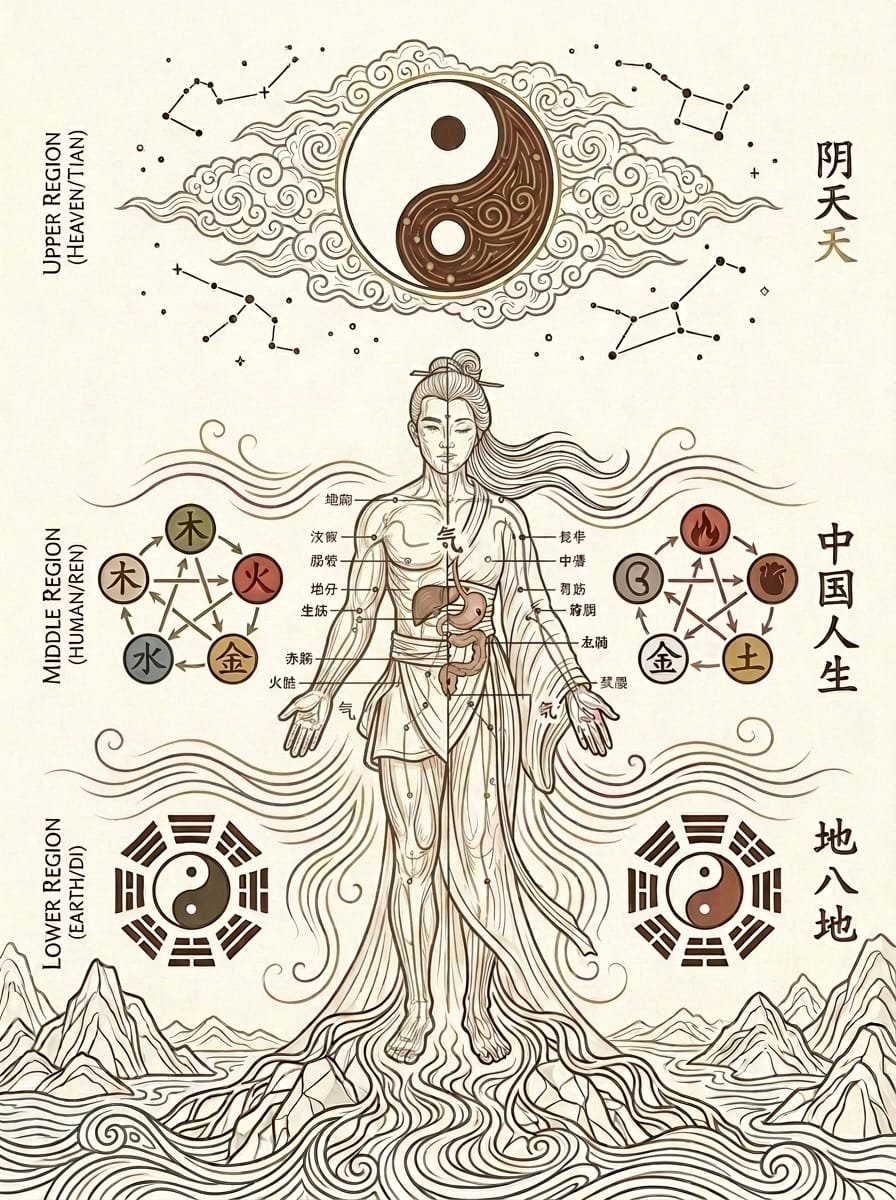
It divides the body into three connected regions:
- Upper Region — Heaven
- Middle Region — Human
- Lower Region — Earth
These regions help organise the movement, breath, nourishment and everyday wellbeing guidance found throughout MapMeHealthy.
They are not separate compartments.
They are three parts of one living, breathing whole.
Why Use a Body Map?
Modern life encourages us to treat the body like a collection of unrelated parts.
A sore neck goes in one box.
Poor sleep goes in another.
Digestion, hormones, emotions, work stress and tired feet are all filed separately.
The body is not nearly that tidy.
A demanding day may settle in your shoulders.
A worried mind may disturb your breathing.
Rushing through meals may leave the middle of the body feeling unsettled.
Feeling ungrounded may show up as fatigue, restlessness or a sense that you are never quite fully present.
The Body Map helps you begin with a simple question:
Where is my body asking for attention today?
You do not need to analyse everything.
You simply notice, choose a starting point and respond gently.
The Three Regions
Upper Region — Heaven
Clarity, breath and inner quiet
The Upper Region includes the head, eyes, face, neck and shoulders.
It is often where we feel:
- Mental overload
- Screen fatigue
- Tight shoulders
- A busy or scattered mind
- Difficulty switching off
- Shallow or restricted breathing
- The sense that all our energy has risen into the head
The Upper Region is not only about thinking.
It is also about how we see, listen, focus and make room for quiet.
Practices for this region may include gentle movement, breath awareness, eye and shoulder relaxation, stillness and simple ways to settle an overworked mind.
Begin here when you feel as though your head has been running the whole household on its own.
Middle Region — Human
Harmony, breath and emotional flow
The Middle Region includes the chest, ribs, abdomen, waist and centre of the body.
It is often where we feel:
- Emotional tension
- Breath held high in the chest
- Digestive discomfort
- A tight or guarded middle
- Fatigue after carrying too much
- Unease during hormonal or life transitions
- The feeling that everything has become stuck
This region is called Human because it sits between Heaven and Earth.
It is where thought, feeling, breath, nourishment and daily life meet.
The Middle Region reminds us that emotions are not floating somewhere outside the body.
They have weight, rhythm and movement.
Practices for this region may include circular movement, relaxed breathing, gentle centre-focused Qigong, seasonal nourishment and simple ways to make more space around what you are carrying.
Begin here when life feels heavy in the middle.
Lower Region — Earth
Grounding, strength and stability
The Lower Region includes the pelvis, hips, legs and feet.
It is often where we notice:
- Tired or heavy legs
- Poor balance
- Tight hips
- Physical weakness
- A lack of grounding
- Reduced confidence in movement
- The sense that the body has lost its roots
The Lower Region connects us to the ground beneath us.
It supports balance, mobility, physical confidence and the ability to move through life with greater steadiness.
Practices for this region may include slow weight shifting, gentle strengthening, foot awareness, grounded movement and supportive work for balance and healthy ageing.
Begin here when you need to come back down to earth — quite literally.
No Region Works Alone
The Three Regions are useful, but they are never isolated.
The Upper Region may feel overloaded because you have not rested.
The Middle Region may feel unsettled because you are rushing.
The Lower Region may feel weak because you have spent too much time sitting and too little time connected to the ground.
One region often influences another.
For example:
- Softer breathing may ease the shoulders.
- Grounding the feet may quiet the mind.
- Gentle movement through the middle may support fuller breathing.
- Eating regularly may improve steadiness and concentration.
- Rest may change the way the whole body responds.
This is why the Body Map is not a symptom checklist.
It is a way of seeing relationships.
Where the Body Map Comes From
The Body Map draws inspiration from traditional Chinese understandings of Heaven, Human and Earth, together with Amanda Lan’s decades of experience in martial arts, Health Qigong, movement teaching and women-centred wellbeing.
It also reflects something very practical:
People need a simple way to know where to begin.
Traditional systems can be rich and valuable, but they can also become overwhelming when all you really need is a quiet starting point after a difficult day.
The Body Map translates broad principles into an accessible structure for modern life.
It does not replace traditional teaching.
It helps ordinary people find a doorway into practice.
The Body Map and BalanceHER
BalanceHER is an important women-specific foundation, not the boundary of MapMeHealthy's
method for movement, breath, nourishment and wellbeing through the different seasons of life.
MapMeHealthy is its practical online home.
The Body Map provides the structure that connects the two.
It helps organise guidance for experiences such as:
- Mental and emotional overload
- Screen-related tension
- Hormonal transitions
- Changes in energy
- Grief and loneliness
- Reduced balance or mobility
- The need for steadier nourishment
- Healthy ageing
- The ordinary wear and tear of being human
BalanceHER begins with women because women’s embodied experiences have often been treated as secondary or inconvenient.
The Body Map offers a way to return attention to the whole person.
This Is Not About Diagnosing Yourself
A tight shoulder does not always have one meaning.
Fatigue does not always come from one place.
An unsettled stomach, busy mind or heavy body may have many possible causes.
The Body Map is not designed to diagnose illness or tell you exactly what is “wrong.”
It helps you notice patterns and choose gentle, appropriate support.
You might ask:
- Where do I feel tension?
- Where do I feel disconnected?
- Where do I feel tired?
- Where does my breathing feel restricted?
- Which part of me needs less effort today?
- Do I need quiet, nourishment or grounding?
Sometimes the body needs movement.
Sometimes it needs food.
Sometimes it needs rest, medical care or a proper conversation.
Listening also means knowing when self-guidance is not enough.
How to Use the Body Map
1. Notice
Pause for a moment.
Without trying to change anything, notice where your attention goes first.
Is it your head, shoulders, chest, stomach, hips, legs or feet?
2. Choose a Region
Start with the region that feels most present.
You do not need to choose perfectly.
The regions overlap, and you can always explore another one later.
3. Choose One Small Practice
Read one article.
Try one gentle movement.
Take a few slower breaths.
Prepare something nourishing.
Do less than you think you should.
4. Notice Again
After the practice, pause.
Has anything changed?
You may feel more settled, more aware or simply more honest about what you need.
Even noticing that you are tired is useful information.
5. Return When Needed
There is no correct sequence and no final level to reach.
The Body Map is not something you complete.
It is something you return to.
Begin With the Region That Speaks Loudest
Upper Region
For screen fatigue, busy thoughts, eye strain, neck and shoulder tension, breath and calm.
Middle Region
For breath, emotional rhythm, digestion, nourishment and transitions through the centre of the body.
Lower Region
For grounding, hips, legs, feet, mobility, balance and healthy ageing.
Visit the Region
Explore at Your Own Pace
You can begin with the free practices, articles and Food Alchemy guidance available throughout MapMeHealthy.
For those who would like a little more continuity, MapMeHealthy Access offers a gentle monthly BalanceHER membership with guided practices, seasonal nourishment and new Body Map pathways.
Nothing asks you to keep up.
Nothing is designed to make you feel behind.
A Gentle Health Note
The Body Map provides general well-being education and does not diagnose or treat medical conditions.
Move within a comfortable range and stop if you experience pain, dizziness, unusual shortness of breath or worsening symptoms.
Seek appropriate professional guidance for persistent symptoms, injuries, pregnancy, recovery from surgery or any medical concern.
Your Body Is Already Speaking
You do not have to understand everything before you begin.
You do not need a perfect routine.
You only need enough quiet to notice where you are today.
Then begin there.